Rethinking the Bench: The New Economics of System Integrators
The economics of system integrators and consultancies are changing quickly.
Rising salary costs, volatile demand, tighter client scrutiny on value, and the rapid advancement in technology are forcing services firms to rethink how they innovate, sell, and deliver. One of the most significant changes underway is how SIs, consultancies, and specialist services firms think about their “bench”.
For decades, the traditional bench has been treated as a necessary cost of doing business. Firms hired ahead of demand, carried underutilised talent between engagements, and absorbed the cost in return for delivery certainty.
That model is now under serious pressure.
The bench was never just about client delivery
The bench has always served two purposes.
Yes, it exists to support client delivery. But it has also quietly funded internal activity. Product development, accelerators, IP creation, internal tools, pre-sales support, marketing initiatives, and experimentation have all relied on bench time.
As consultancies evolve to pursue higher-margin, scalable opportunities, this internal role of the bench is becoming even more important.
Many firms are no longer content to be pure delivery engines. They are developing products, platforms, and repeatable offerings to respond to market demand and protect margins. However, the traditional bench is a costly and inefficient way to support this ambition.
Why the traditional bench model is breaking down
On paper, the traditional bench provides stability. In practice, it introduces a number of structural challenges.
It is expensive. Salaries, benefits, training, management overhead, and idle time sit on the P&L regardless of utilisation. When demand softens, margins erode quickly.
It is inefficient. Skills age fast, particularly in cloud, data, AI, and security. Firms often carry skills that no longer align with what clients are buying, while still struggling to staff new types of work.
It limits flexibility. Hiring cycles are slow, notice periods are long, and the ability to respond to sudden changes in demand is constrained.
It distorts innovation economics. Internal initiatives are funded opportunistically when people are “free”, making it difficult to understand true investment levels, cost, or return.
The result is a model that assumes predictability in a market that has become anything but predictable.
A more profitable bench is emerging
High performing consultancies are responding by embracing a different approach: the on-demand tech skills bench.
Rather than holding a large, fixed internal bench, firms are building elastic delivery models. A strong core team is complemented by rapid access to specialist skills, brought in only when required.
This is not about replacing permanent teams. It is about using and augmenting them more effectively for today’s era of business uncertainty.
An on-demand tech skills bench allows firms to scale delivery without carrying long-term cost, access niche and emerging skills without permanent hires, and protect margins while taking on more work.
Importantly, it supports both client delivery and internal initiatives, without relying on idle capacity.
The economics of two delivery benches
The table below highlights the fundamental economic differences between the traditional full-time employee bench and an on-demand tech skills bench.
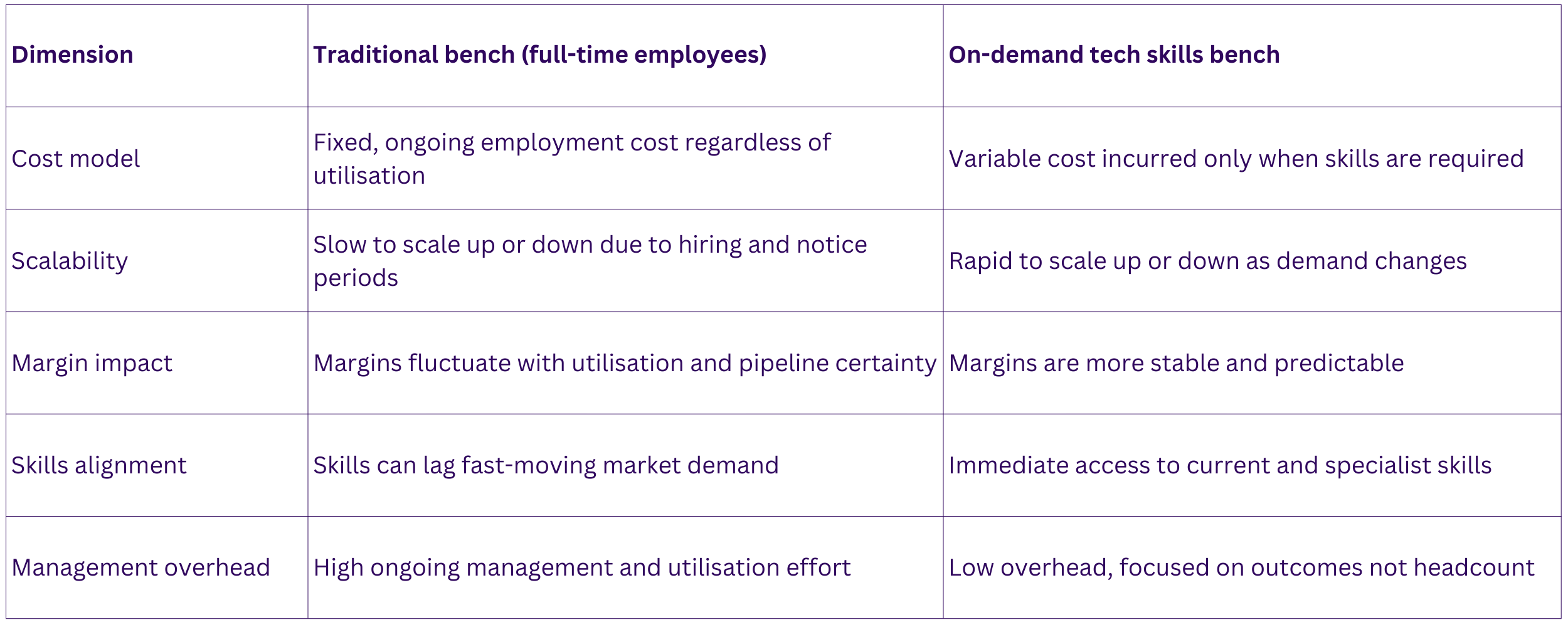
From bench management to capability orchestration
This shift represents more than a staffing change. It is a move from bench management to capability orchestration.
Instead of asking “who do we have available?”, leading firms ask “what capabilities do we need to deliver this outcome, and how quickly can we assemble them?”
For internal initiatives, this is transformative. Product teams, innovation squads, and platform builds can be funded deliberately, with defined scope, budget, and success criteria, rather than being squeezed into gaps between client projects.
Client delivery remains focused on utilisation and quality. Innovation becomes intentional rather than accidental.
A cleaner view of profitability and growth
One of the most powerful outcomes is financial clarity.
Client margins are easier to forecast and protect. Internal investment is visible and measurable. Leaders gain a clearer understanding of what drives profitability and what drives future growth.
This clarity is becoming essential as consultancies pursue product-led and platform-based strategies alongside traditional services revenue.
The future bench is liquid
The most successful consultancies are not eliminating the bench. They are redefining it.
A strong core team provides continuity, culture, and client trust. An on-demand skills bench provides speed, flexibility, and access to scarce capability without permanent cost.
This is why many profitable consultancies are extending their delivery and innovation capacity through an on-demand tech skills bench from partners such as BrightBox.
The traditional bench is becoming a liability. The on-demand skills bench is becoming a competitive advantage.