From location-based resourcing to on-demand tech skills
For years, organisations have framed technology resourcing decisions around location. Onshore, nearshore, offshore, each chosen to balance cost, control, and access to talent.
That framing is no longer sufficient.
Modern technology work is faster, more specialised, and less predictable than the delivery models it was built on. The organisations pulling ahead are no longer asking where work should be done first. They are asking what skills are needed, for how long, and to deliver which outcomes, with location chosen second. This marks the shift from location-based resourcing to on demand tech skills as a new operating model.
Onshore, nearshore, and offshore models were designed for a world where work was relatively stable, projects followed linear plans, and skills demand was predictable. In that environment, it made sense to assemble teams by location and focus on utilisation.
Today’s reality looks very different. AI, data, cloud, integration, security, and automation initiatives are highly specialised, intermittent rather than continuous, iterative and fast changing, and difficult to plan months in advance. The constraint is no longer geography. The constraint is access to the right skills at the right moment.
Leading organisations now reverse the traditional sequence. They identify the specific skills required, define how long those skills are needed, align them to outcomes and delivery phases, and only then select the most appropriate location or mix of locations. This approach treats location as a delivery choice, not a strategy in itself. On demand tech skills make this possible by decoupling capability from fixed teams and long-term capacity commitments.
The difference between location led and on demand models becomes clear when viewed side by side.
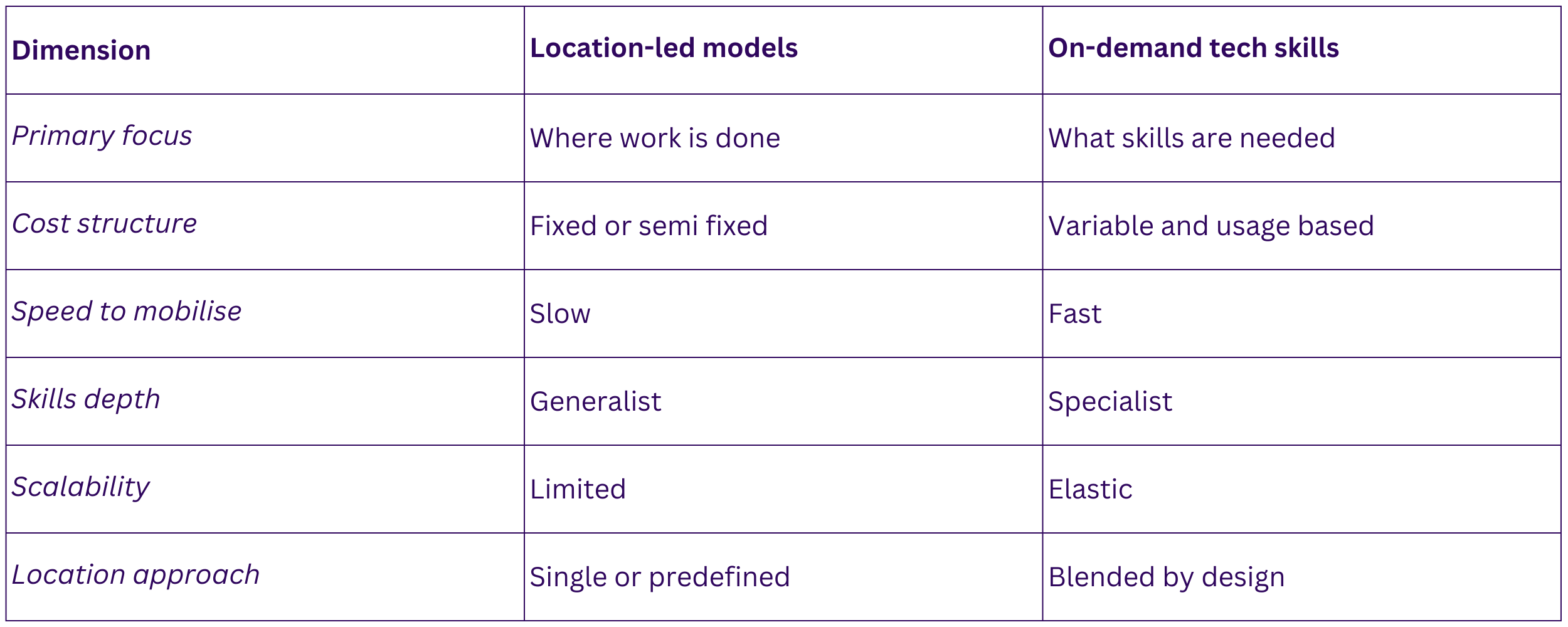
This is not about replacing onshore, nearshore, or offshore delivery. It is about orchestrating them more intelligently.
On demand does not ignore location. It enables blended delivery models by design. Most organisations combine a small, stable onshore core for leadership, architecture, and stakeholder alignment, nearshore teams to accelerate sustained development, and offshore or global specialists for niche or short-term expertise. What changes is the logic. Skills drive the model. Location supports it.
Two practical examples bring this to life.
A fast-scaling technology company expanding into new markets sees its product roadmap evolve constantly. It needs architects early, data and AI specialists' mid cycle, and security expertise at specific compliance milestones. Rather than hiring ahead of uncertain demand, the company keeps a lean onshore core for product direction and decision making, activates nearshore engineers during peak build phases, and engages global specialists on demand for short, high impact needs. The result is speed without excess cost and access to deep expertise without long term commitments.
A consultancy supporting multiple clients across data, AI, and digital transformation faces fluctuating demand, where maintaining a traditional bench erodes margins. The firm retains onshore leadership and client facing roles, draws on nearshore delivery teams as projects land, and uses on demand specialists for AI, integration, or regulated work. This allows the consultancy to respond faster to opportunities, reduce idle cost, and protect profitability without sacrificing delivery quality.
Why on-demand fits modern delivery.
Modern technology programmes rarely require the same skills, at the same intensity, throughout their lifecycle. They need architects early, builders during execution, specialists at key inflection points, and optimisation skills later on. On demand tech skills allow organisations to plug expertise in and out as needs evolve, aligning cost to value and capacity to reality.
As organisations adopt skill first, blended delivery models, many are partnering with providers that specialise in orchestrating on demand capability at scale. BrightBox operates one of the largest global communities of on-demand technology skills, giving organisations rapid access to specialist expertise across data, AI, cloud, integration, and digital platforms. Skills are deployed flexibly across onshore, nearshore, and offshore locations based on what each engagement requires. This reflects the broader shift underway, from building and carrying capacity to accessing skills precisely when and where they create the most value.
Onshore, nearshore, and offshore delivery will continue to exist, but they are no longer the strategic decision. The real question is how quickly an organisation can access the right skills, exactly when they are needed, and deploy them across the right mix of locations without carrying unnecessary cost when demand shifts. That is the question on demand tech skills are designed to answer, and why they represent the new model rather than just another sourcing option.